Nasce a Trieste Ifpu, il centro per scoprire i segreti del cosmo
La sigla sta per Istituto per la fisica fondamentale dell’universo. Oggi l’inaugurazione nel campus Sissa di Miramare  
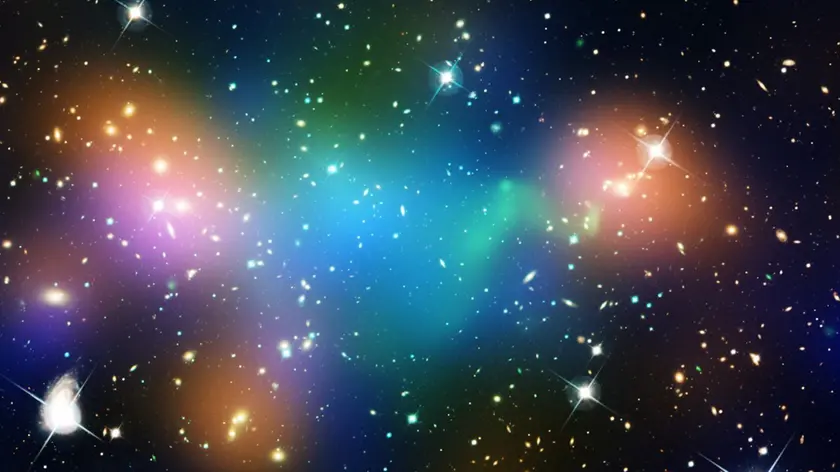
epa03129685 A handout composite image made available by NASA 02 March 2012 showing the distribution of dark matter, galaxies, and hot gas in the core of the merging galaxy cluster Abell 520, 2.4 billion light-years away, and formed from a violent collision of massive galaxy clusters. The natural-color image of the galaxies was taken with NASA's Hubble Space Telescope and with the Canada-France-Hawaii Telescope in Hawaii. Superimposed on the image are "false-colored" maps showing the concentration of starlight, hot gas, and dark matter in the cluster. Starlight from galaxies, derived from observations by the Canada-France-Hawaii Telescope, is colored orange. The green-tinted regions show hot gas, as detected by NASA's Chandra X-ray Observatory. The gas is evidence that a collision took place. The blue-colored areas pinpoint the location of most of the mass in the cluster, which is dominated by dark matter. Dark matter is an invisible substance that makes up most of the universe's mass. The dark-matter map was derived from the Hubble Wide Field Planetary Camera 2 observations by detecting how light from distant objects is distorted by the cluster of galaxies, an effect called gravitational lensing. The blend of blue and green in the center of the image reveals that a clump of dark matter resides near most of the hot gas, where very few galaxies are found. This finding confirms previous observations of a dark-matter core in the cluster. The result could present a challenge to basic theories of dark matter, which predict that galaxies should be anchored to dark matter, even during the shock of a collision. EPA/M. J. LEE / HANDOUT EDITORIAL USE ONLY

TRIESTE La “cattura” del bosone di Higgs. Il cosmo primordiale disegnato dal satellite Planck. Le attesissime onde gravitazionali provocate dallo scontro tra buchi neri e stelle di neutroni. Scoperte che hanno eccitato la mente non solo degli scienziati. Saranno questi (oltre a materia oscura ed energia oscura, asimmetria materia-antimateria, neutrini, gravità e quant’altro) i territori di ricerca su cui si confronterà il nuovo istituto che nasce ufficialmente oggi a Trieste. La sigla è IFPU, che sta per Institute for Fundamental Physics of Universe: ovvero Istituto per la fisica fondamentale dell’Universo.

La cerimonia inaugurale del nuovo istituto avviene questa mattina alle 10.30 nell’aula magna del campus della Sissa a Miramare, in via Beirut. Interverranno i responsabili delle quattro prestigiose istituzioni che hanno dato vita all’IFPU: vale a dire il direttore della Sissa Stefano Ruffo, il direttore dell’Ictp Fernando Quevedo, il presidente dell’Inaf (Istituto nazionale di astrofisica) Nicolò D’Amico, il presidente dell’Infn (Istituto nazionale di fisica nucleare) Fernando Ferroni.

Il keynote address, il discorso scientifico che traccerà la strategia dell’IFPU, è stato affidato a un personaggio d’eccezione della cosmologia: George Ellis, fellow della Royal Society, professore emerito di matematica applicata all’Università di Cape Town, in Sud Africa, il paese dov’è nato 79 anni anni fa. Il titolo del suo intervento: “A remarkable interaction: fundamental physics, astrophysica, and cosmology”. Per Ellis sarà un ritorno emozionante nella nostra città, dove dal 1987 al 1994 è stato professore di fisica cosmica alla Sissa durante il periodo più oscuro dell’apartheid in Sud Africa. Tornato in patria, accanto al lavoro scientifico Ellis non ha dimenticato il suo impegno politico: nel 1999 ha ricevuto da Nelson Mandela la Star of South Africa Medal, la più importante onorificenza sudafricana.

L’IFPU nasce all’insegna della multidisciplinarietà e della collaborazione internazionale, con un budget di 1,7 milioni di euro per i primi quattro anni. Un importo già usato in parte anche per il ripristino dell’edificio prospiciente la vecchia Sissa, dove l’IFPU avrà sede.

Spiega Stefano Liberati, coordinatore dell’area di Fisica della Sissa, uno dei promotori del nuovo istituto: «L’IFPU avrà una duplice missione. Da una parte creare sinergie tra i fisici teorici e sperimentali locali; dall’altra realizzare una massa critica per diventare un punto di riferimento nella collaborazione internazionale su questi temi d’avanguardia attraverso il finanziamento di programmi di ricerca, workshop, visite e altre attività. Saranno una ventina i fisici triestini coinvolti a tempo parziale come resident scientist per promuovere iniziative molto focalizzate, con due o tre studenti post-doc all’anno. Siamo fiduciosi che questo istituto contribuirà all’esplorazione delle leggi fondamentali della natura nel laboratorio dell’Universo». —


Argomenti:scienzaricerca

Riproduzione riservata © Il Piccolo